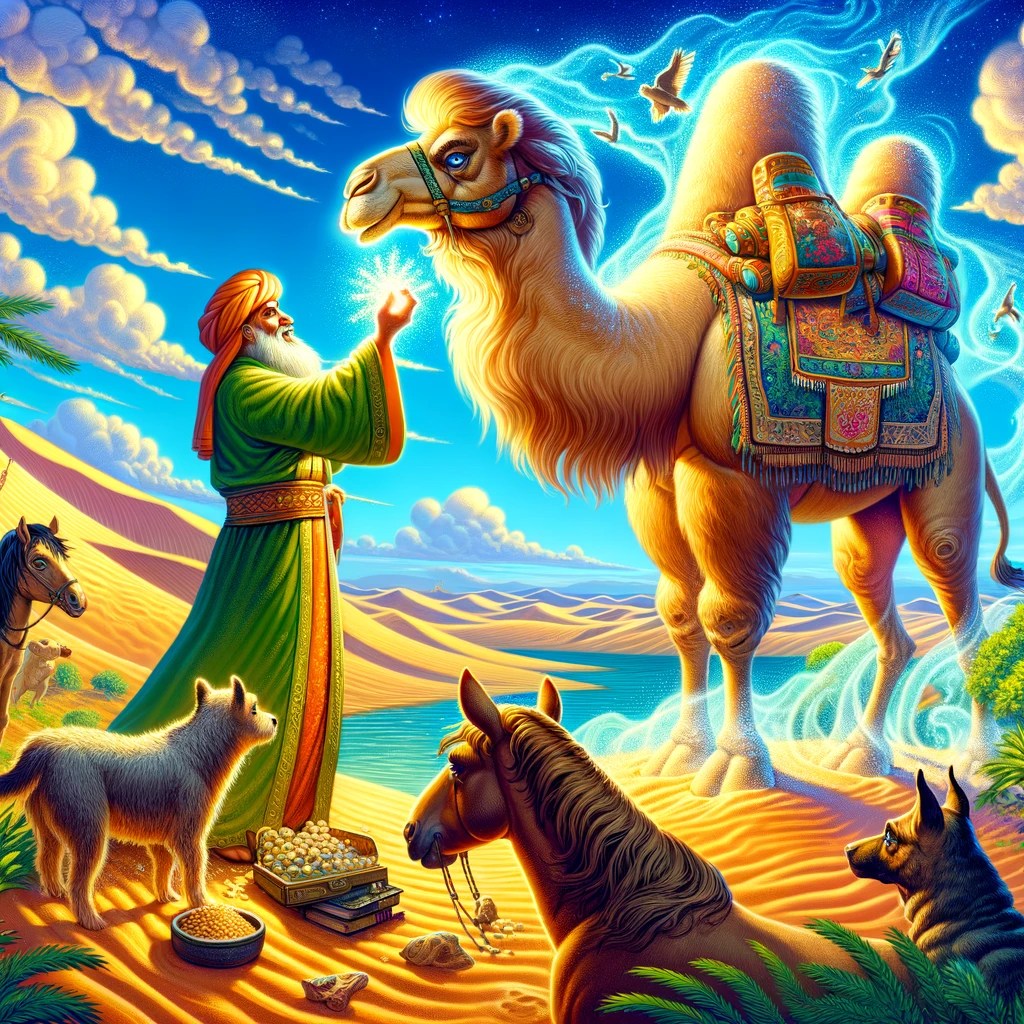
The following is a adaption of the famous tale “How the Camel got his Hump” from the book “Just So Stories by Rudyard Kipling.
Once upon a time, when the Earth was still dressing itself in its new colors and shapes, there lived a unique group of animals, each with their roles in this fresh, bustling world. Among them, the Camel stood out—not for his contributions but for his remarkable laziness. In the heart of the vast Howling Desert, he found his comfort among sticks, stones, and tamarisks, content with doing absolutely nothing but munching and lounging under the sun’s watchful eye.
One bright Monday, Horse, with a lively trot and a heart full of duty, approached Camel. “Come join us in our work,” Horse invited, only to be met with a dismissive “Humph” from Camel. This response, void of any intent to participate, echoed through the desert air, leaving Horse in disbelief.
As days passed, Dog and Ox, each busy with their tasks, tried to encourage Camel to share their load. Yet, all attempts were met with the same indifferent “Humph,” a word that seemed to form the entirety of Camel’s vocabulary. The animals, bewildered and frustrated, relayed their concerns to Man, the orchestrator of their work.
Acknowledging the imbalance, Man declared that the other animals must work harder to compensate for Camel’s idleness. This decision, though necessary, weighed heavily on their spirits, and a sense of injustice filled the air.
The turning point came with the arrival of the Djinn, the guardian spirit of the deserts. Upon hearing of Camel’s refusal to contribute, the Djinn confronted him, offering a chance for redemption. Yet, Camel remained steadfast in his laziness, replying with his customary “Humph.”
In that moment, the Djinn, through a sparkle of desert magic, gifted Camel with a hump. This was no ordinary hump, but a reservoir for food and drink, allowing Camel to work for days without pause. Camel’s once sleek back transformed, marking him forever with a symbol of his laziness.
And so, the Camel, humbled and changed, joined the ranks of those who toil under the sun. Though he carries his hump as a reminder of the days lost in idleness, he also carries the lesson of contribution and the value of work.
To this day, the Camel’s hump stands as a testament to the importance of sharing the load, a reminder that in a world so new and full of possibility, every contribution counts. And though he tries to catch up with the time he once squandered, Camel continues to learn, step by step, the true meaning of responsibility and teamwork.
THE Camel’s hump is an ugly lump
Which well you may see at the Zoo;
But uglier yet is the hump we get
From having too little to do.
Kiddies and grown-ups too-of-oo,
If we haven’t enough to do-oo-oo,
We get the hump—
Cameelious hump—
The hump that is black and blue!
We climb out of bed with a frouzly head
And a snarly-yarly voice.
We shiver and scowl and we grunt and we growl
At our bath and our boots and our toys;
And there ought to be a corner for me
(And I know there is one for you)
When we get the hump—
Cameelious hump—
The hump that is black and blue!
The cure for this ill is not to sit still,
Or frowst with a book by the fire;
But to take a large hoe and a shovel also,
And dig till you gently perspire;
And then you will find that the sun and the wind,
And the Djinn of the Garden too,
Have lifted the hump—
The horrible hump—
The hump that is black and blue!
I get it as well as you-oo-oo—
If I haven’t enough to do-oo-oo—
We all get hump—
Cameelious hump—
Kiddies and grown-ups too!
By Rudyard Kipling




Leave a comment